
Quick answer
Key takeaways
- A minimum of 2 mm per QR module ensures readability on most smartphones.
- Higher error‑correction (Level H) allows slightly smaller modules but reduces data capacity.
- For a viewing distance of d meters, the QR size should be at least d × 10 mm (rule of thumb).
Basic size formula
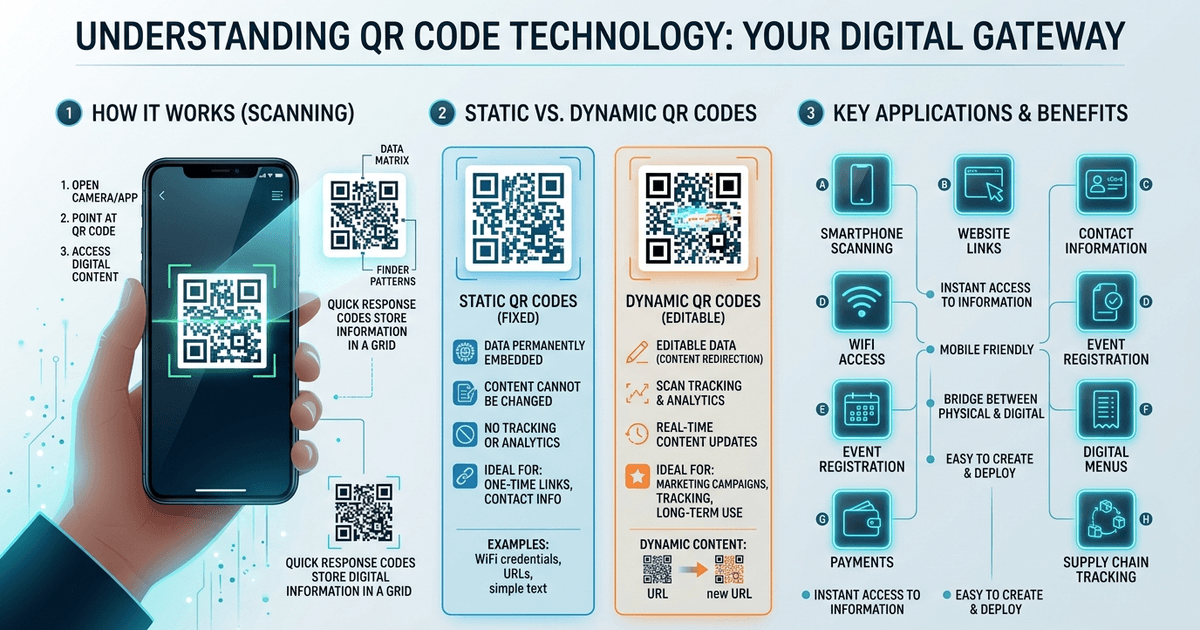
A QR code is composed of a grid of modules. The overall dimension (in mm) is **module size × number of modules**. For reliable scanning, each module should be at least 0.5 mm, but 0.75-1 mm is recommended for mobile cameras. The number of modules depends on the QR version (e.g., Version 2 = 25 × 25 modules, Version 10 = 57 × 57).
Scanning distance guidelines
A simple rule of thumb is **size (mm) ≈ 10 × distance (m)**. For a QR placed on a poster viewed from 2 m away, aim for at least 20 mm side length. For business cards (≈30 mm distance), a 30 mm QR works well.
Solve it now
Use the free QR Code Maker tool
The guide explains the problem. The tool helps you prepare the actual file online.
Create your QR code nowPrint resolution considerations
When printing at 300 DPI, each millimetre corresponds to about 12 pixels. Ensure the generated QR image has at least **12 pixels per module** to avoid blurring. Our tool outputs vector SVG (or high‑resolution PNG) so you can scale without losing quality.
Quick size calculator
**Step 1** - Choose the QR version (or let the generator pick automatically). **Step 2** - Set the scanning distance in metres. **Step 3** - Compute required side length: `distance × 10 mm`. **Step 4** - Divide by the number of modules to get the module size. If the result is below 0.75 mm, bump up the version or reduce error‑correction.
Practical checklist before you finish
Before you download or upload the final file, check the details that usually create rejection or rework: readability, file format, file size, spelling, page order and the exact instruction written on the form or portal.
For this task, use QR Code Maker as a preparation step, not as a replacement for the official requirement. If a school, office, employer, bank or government portal gives a size, format or document rule, follow that rule first and then use the tool to prepare the file.
- Open the downloaded file once and confirm it is not blank, cropped wrongly or unreadable.
- Use a clear file name so you can identify it later during upload or printing.
- Keep the original file until your submission, printout or sharing task is complete.
- Do not add private pages or unnecessary details when only selected information is required.
The most useful parts of this guide are Basic size formula, Scanning distance guidelines, Print resolution considerations. Read those sections carefully if you are preparing a file for an online form, local photocopy counter, office record or student document work.
Frequently Asked Questions People Search For
Read next
Related blog posts
These guides support the same document, photo, PDF or online-form workflow, so readers can solve the next step without returning to search.
How to Calculate Days Between Dates Online for Forms and Deadlines
Learn how to calculate days between dates, add days, subtract days and count working days for forms, exams, deadlines and office work.
Utility ToolsHow to Calculate GST Online for Bills and Invoices
Learn how to calculate GST online for bills and invoices. Add GST, remove GST, split CGST/SGST or IGST and understand taxable value.
Utility ToolsHow to Calculate Loan EMI Online for Home, Car and Personal Loan
Learn how to calculate loan EMI online for home loan, car loan, personal loan, education loan and business loan with interest and repayment schedule.
Utility ToolsHow to Calculate Percentage Online for Marks, Discount, GST and Profit
Learn how to calculate percentage online for student marks, discount, GST-style amount, reverse percentage, profit/loss, price change and daily shop work.
Written by
Shrikant Yadav
Website Developer, Photocopywala
Shrikant Yadav writes practical Photocopywala guides for photo tools, PDF tools, document preparation, printable resources, government-link safety and online form help for Indian students, job seekers, shop owners and everyday users.
Solve it now
Use the free QR Code Maker tool
The guide explains the problem. The tool helps you prepare the actual file online.
Create your QR code now